


Luigi Antonio Irlandini - official composer site
Namazu
Bestiarium, Livro 2, #2
instrumentation:
four timpani (percussion solo)
T.1: 32” – T.2: 29” – T.3: 26” – T.4: 23"
other versions: --
epigraph: --
score:
LAI-EP 53
duration:
ca. 6'20"
date/place of composition:
23 November to 15 December 2023/
Florianópolis
dedication: --
first performance:
Concert #2 of XXXI Panorama da Música Brasileira Atual,
07 October 2024 - Salão Leopoldo Miguez, Escola de Música da UFRJ, Rio de Janeiro.
Timpani: Tiago Calderano
audio:
https://www.youtube.com/watch?v=65lbcqC_MzQ&list=PLvFygh-apa1M_lAFDqXJ2H5iXB0euGz0L&index=8 starting at 44'50"
notes on the composition:
This is the second piece of the second volume in the Bestiarium series. Namazu (鯰), also called Ōnamasu
(大鯰) , is a gigantic catfish responsible for causing earthquakes and tsunami, according to Japanese mythology. Namazu is kept under control by kami Takemikazuchi, who restrains him under a stone. However, when Takemikazuchi gets distracted, Namazu is able to move, and this results in an earthquake. Growing up in the 1970s in Rio de Janeiro, I would often find street walls that had been graffited by the saying "celacanto provoca maremoto" (coelacanth provokes tsunami). This saying became some sort of a popular carioca "tradition"... It probably originated from the Japanese 1960s television series National Kid, in which a giant fish appears (as the ship of Abyssal creatures) producing tsunami. I believe this fish would have been called Namazu in the film's episodes, since it does look like a catfish, and not as a coelacanth, and it may have been wrongly identified as a coelacanth. To verify this hypothesis, I would need to watch National Kid again with its original sound, searching for someone in the story mentioning the name Namazu or coelacanth...
notas sobre a composição:
Esta é a segunda peça do segundo volume da série Bestiarium. Namazu (鯰), também chamado Ōnamasu (大鯰) , é um bagre gigante responsável por causar terremotos e maremotos, conforme a mitologia japonesa. Namazu é controlado pelo kami Takemikazuchi, que o mantém seguro debaixo de uma pedra. Entretanto, quando Takemikazuchi se distrái, Namazu consegue se mexer, e isto resulta em um terremoto.
Crescendo nos anos 1970 no Rio de Janeiro, eu encontrava pela cidade, com frequência, muros pixados com o dito "celacanto provoca maremoto". Este dito acabou por tornar-se uma espécie de "tradição" carioca... Provavelmente originou-se a partir do seriado de televisão japonesa dos anos 1960, National Kid, no qual um peixe gigante aparece (trata-se da embarcação das criaturas Abissais) produzindo tsunami. Acredito que este peixe teria sido chamado Namazu nos episódios do filme, já que parecia-se com um peixe gato, e não com um celacanto, e talvez tenha sido erroneamente identificado como um celacanto. Para verificar esta hipótese, seria necessário assistir National Kid novamente, procurando, no som original, por alguém mencionando o nome Namazu ou celacanto...
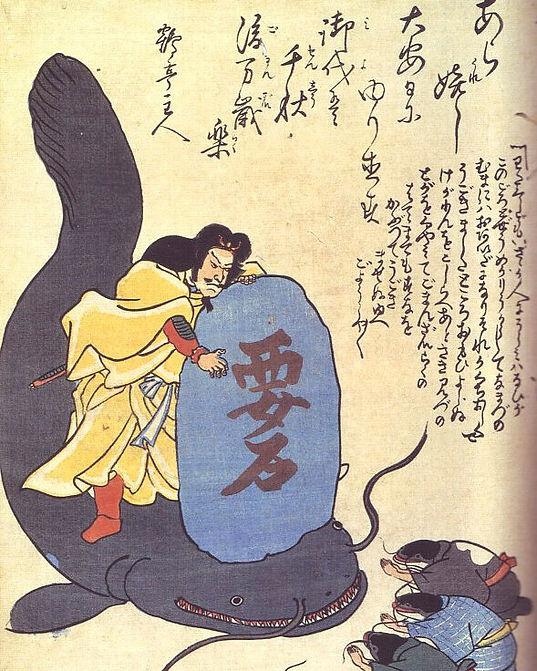
Kashima restricting Namazu, 1885 print, rom LEWIS, T.A.(ed) (1985): Volcano (Planet Earth). Time-Life Books: 176 http://historyofgeology.fieldofscience.com/2011/01/namazu-earthshaker.html