


Luigi Antonio Irlandini - official composer site

Encontro Internacional de Shakuhachi de Santa Catarina
Santa Catarina International Shakuhachi Encounter
EISSC, Encontro Internacional de Shakuhachi de Santa Catarina (Santa Catarina Internacional Shakuhachi Encounter) was founded in 2019 by Luigi Antonio Irlandini to create venues in Brazil for the music of the Japanese bamboo flute, the shakuhachi.
The First EISSC took place in the Santa Catarina cities of Florianópolis and Laguna in October 2019. The part in Laguna was organized by maker and player Henrique Elias Sulzbacher with support of the Coruja Buraqueira Bookshop and Dōjō Kobukan. The Florianópolis part was organized by Luigi Antonio Irlandini with support of Fundação Cultural BADESC and UDESC (Universidade do Estado de Santa Catarina). The First EISSC was modestly called "Encontro de Shakuhachi de Santa Catarina - ESSC 2019", but in reality it was already an international event because it brought Swiss shakuhachist Marco Lienhardt to teach and perform.
The Second EISSC took place in Florianópolis in September 2023 and was organized by Irlandini with support of Fundação Cultural BADESC, Research Group PROMUSI, UDESC, and the Research Institute FAPESC (Fundação de Amparo à Pesquisa e Inovação do Estado de Santa Catarina). The international guest was Rafael Hiroshi Fuchigami.
SCROLL DOWN FOR ENGLISH INFORMATION AND
CALL FOR PAPERS AND PERFORMANCES AT EISSC-III
O Terceiro Encontro Internacional de Shakuhachi de Santa Catarina (EISSC-III), será realizado nos dias 23 a 26 de setembro de 2026 na cidade de Florianópolis, executado pelo Departamento de Música e Programa de Pós-Graduação em Música (PPGMUS) da Universidade do Estado de Santa Catarina (UDESC) com a coordenação do Prof. Dr. Luigi Antonio Irlandini. O evento oferece à comunidade florianopolitana diversas atividades centradas no shakuhachi, a flauta de bambu japonesa de tradição zen budista, como nas outras duas edições anteriores do EISSC, realizadas em 2019 e 2023. Porém, esta terceira edição do EISSC se expande para incluir três outros instrumentos de sopro tradicionais japoneses que formam a base do antiquíssimo ensemble Gagaku da música de corte imperial do Japão desde o período Heian (794-1185): são eles o ryūteki (flauta transversa), o hichiriki (sopro de palheta dupla) e o shō (órgão de boca). Provavelmente, esta será a primeira vez que estes instrumentos e repertório musical serão ouvidos ao vivo no Brasil, mas, certamente, em Florianópolis.
CONVIDADOS INTERNACIONAIS / INTERNATIONAL GUESTS:
Akihito Obama Gagaku Trio Lish Lindsey - Fabio Rambelli - Thomas Piercy
CLIQUE AQUI PARA VER A PROGRAMAÇÃO OFICIAL DO EISSC-III
O EISSC-III realizará diversas atividades:
o Simpósio Internacional de Estudos de Shakuhachi e Gagaku estará aberto a todos os pesquisadores de qualquer estilo de música tradicional e moderna para shakuhachi e/ou instrumentos gagaku. Aqueles que participarem do Simpósio terão a oportunidade de compartilhar suas ideias em comunicações orais que serão publicadas no EISSC-III Symposium Proceedings - Anais do Simpósio Internacional de Estudos de Shakuhachi e Gagaku EISSC-III.
Oficinas de Shakuhachi com Akihito Obama Sensei serão oferecidas a estudantes de shakuhachi intermediários e avançados. Oficinas de Shakuhachi com Henrique Elias Sulzbacher serão oferecidas a estudantes de shakuhachi iniciantes.
Três palestras serão realizadas pelos convidados Akihito Obama, Thomas Piercy, Lish Lindsey, Fabio Rambelli, Danton Oestreich, e pelo organizados Luigi Antonio Irlandini. Os mesmos participarão de uma Mesa Redonda no último dia do Encontro.
Três concertos noturnos apresentarão músicas tradicionais e modernas: Duo Obama-Oestreich (shakuhachi e violão), o Gagaku Trio, e um concerto com todos os convidados e Luigi Antonio Irlandini.
EISSC III
Symposium - Lectures
Shakuhachi Workshops - Concerts
The Third International Shakuhachi Encounter of Santa Catarina (EISSC-III) will take place in the city of Florianópolis, in the State of Santa Catarina, Brazil, on September 23 - 26, 2026, carried out by the Department of Music and the Graduate Music Program of the Santa Catarina State University (Universidade do Estado de Santa Catarina - UDESC), coordinated by Prof. Dr. Luigi Antonio Irlandini. The Encounter offers to the city's communities several activities centred on the shakuhachi, the Zen Buddhist bamboo flute, as in the other two previous editions of EISSC, which happened in 2019 and 2023. However, this third edition of EISSC has been expanded to include three other traditional winds instruments that form the basis of the ancient imperial court music ensemble, Gagaku, since the Heian Period (794-1185): these are the ryūteki (flute), the hichiriki (double reed instrument) and the shō (mouth organ). This will be one of the first few times in which these instruments and their musical repertoire will be heard and seen live in Brazil.
CLICK HERE FOR THE OFFICIAL EISSC-III PROGRAM
In EISSC-III there will be several activities:
the International Symposium on Shakuhachi and Gagaku Studies is open to all researchers of any style of traditional and modern music for shakuhachi and/or gagaku instruments. Those participating researchers will have the opportunity to share their research and ideas in oral communications, which will be published at the EISSC-III Symposium Proceedings (Anais do Simpósio Internacional de Estudos de Shakuhachi e Gagaku EISSC-III).
Shakuhachi workshops will be offered to intermediate and advanced shakuhachi students by Akihito Obama Sensei.
Three lectures will be offered by the guests Akihito Obama, Thomas Piercy, Lish Lindsey and Fabio Rambelli, Danton Oestreich and Luigi Antonio Irlandini. A round-table discussion will also take place in the last day of the Encounter.
Three evening concerts will be offered, by the Duo Obama-Oestreich (shakuhachi and guitar), the Gagaku Trio, and with all guests and Luigi Antonio Irlandini, performing traditional and modern music.
Shakuhachi Workshops
APPLICATION FOR THE SHAKUHACHI WORKSHOPS:
1. Application for the Shakuhachi Workshops is free and independent from submitting to the Symposium. Those interested in participating in both Workshops and the Symposium need to submit a separate submission/application e-mail message for each activity.
2. Deadline for applying fot the Shakuhachi Workshops; extended until September 10, 2026.
3.Send your application for the Shakuhachi Workshop to the e-mail shakuhachiencounter@gmail.com.
4. Application e-mail message should contain:
* Full name;
* Address;
* attached copy of an identification document with photo (driver's license, passport, identity);
* brief biographic description of your musical and shakuhachi activities;
* indicate your level: BEGGINER, INTERMEDIARY, ADVANCED
5. Workshops for begginers will have PVC shakuhachi made available by the teacher.
6. Intermediary and advanced students should bring their own instrument.
EISSC-III Symposium on Shakuhachi and Gagaku Studies
Call for Papers & Performances
The third edition of the International Shakuhachi Encounter of Santa Catarina innovates itself by including in its scope the Gagaku winds instruments – ryūteki, hichiriki and shō – and invites all interested parties to submit research paper and performance proposals for the EISSC-III Symposium of Shakuhachi and Gagaku Studies. The Encounter will be held from the 23rd to the 26th of September, 2026, in the city of Florianópolis, Brazilian State of Santa Catarina and has been possible with the support of Edital PROEVENTOS from FAPESC (Fundação de Amparo à Pesquisa de Estado de Santa Catarina).
The theme of the Symposium, “Shakuhachi and Gagaku Studies”, aims to encourage the production and presentation of artistic (composition and performance) and intellectual research about all aspects, topics or predicaments related to music made with the shakuhachi and Gagaku instruments, investigating it from any point of view: technical, analytical, aesthetic, poetic, educational, social, cultural, philosophical, historical.
Therefore, the Symposium welcomes not only proposals about traditional repertoires such as Honkyoku, Sankyoku and ancient Gagaku court music but also about repertoires from around the world composed in the 20th and 21st centuries that employ the shakuhachi, Gagaku winds instruments or the entire Gagaku ensemble (including strings and percussion instruments), alone or in any combination with each other and/or with Western, other Japanese traditional instruments or electronics.
Researchers, educators, composers, performers and students that are dedicated to shakuhachi and Gagaku studies are all invited to participate in the EISSC-III Symposium with the goal of sharing their research, knowledge and insights, making possible wide conversations that will foster academic and artistic research and exchange about music from all times made with these traditional Japanese winds instruments.
Submissions deadline: August 1st, 2026
GUIDELINES FOR AUTHORS
Submissions:
1. Each author may submit up to three proposals for evaluation, considering authorship, co-authorship and categories. There are two submissions categories: 1) Paper submission; 2) Performance submission.
2. Paper submissions are intellectual production in the form of an oral 15-minute presentation of the submitted paper, followed by a 5-minute discussion.
3. Performance submissions are artistic production in the form of a 5-minute oral presentation followed by a 10-minute performance of a traditional, modern or original composition.
4. See category-specific instructions below.
5. Submissions must be sent by e-mail to shakuhachiencounter@gmail.com.
6. Any questions or requests may be forwarded to the e-mail address above.
7. All cases, including omitted ones, will be decided by the EISSC-III Symposium Scientific & Artistic Committee.
8. The official languages of the Symposium are Portuguese and English. However, works may be written and presented in Portuguese, Spanish or English.
9. Upon acceptance of the proposal, the author will receive an e-mail message confirming its acceptance and an Event Registration Form to be soon returned completed with the requested data. See “Important Dates” below.
Paper submissions:
1. The paper submission e-mail message should contain:
* Author’s name and academic institution affiliation. Authors without affiliation: please identify yourselves as “Independent Researcher”;
* Author 100-word biography;
* Proposal pdf. attached file containing the Abstract, Paper text (with or without illustrative materials), Bibliographic References and NO marks or information identifying the author.
2. The submission is anonymous: the author’s name must NOT appear in the proposal pdf. file;
PAPER PROPOSALS:
1. The paper proposal will be a pdf. file containing:
* Abstract with up to 150 words explaining the object, methodology and theoretical references;
* Paper text with 2,500 to 3,000 words;
* Citation format: use Author-Date system according to the current Chicago Manual of Style;
* Bibliographic format: follow the current Chicago Manual of Style. See https://www.chicagomanualofstyle.org/tools_citationguide/citation-guide-2.html
2. The submitted proposal must have originated in academic or artistic research and must not have been published nor presented in another event prior to EISSC-III.
3. Proposal format:
A4 page format;
Font Times New Roman, size 12;
Spacing between lines: 1.5
4. Paper text format:
Title in bold, Times New Roman font size 16, centralized;
Paper text of between 2,500 and 3,000 words, regular Times New Roman font size 12, justified on both margins;
Keywords: four keywords separated by dot;
Japanese terms (Honkyoku, Gagaku, etc.) or terms that are not in the language of the text should be in regular font, except in their first appearance in the text, when they should be in italics.
5. Illustration material format:
All illustration material (musical examples, figures, tables, etc.): centralized, with a brief figure caption written on regular font, size 10, centralized;
Make reference to the illustration items in the Paper text.
Performance submissions:
1. The submission is anonymous: the author’s name must NOT appear in the proposal materials (pdf. file and video);
2. The submission e-mail message should contain:
* Author’s name and academic institution affiliation. Authors without affiliation: please identify yourselves as “Independent Researcher”;
* Author 100-word biography;
* Proposal pdf. attached file containing a brief description (up to 200 words) of your performance: instrumentation, title of the piece, date of the piece, creative process of the music being performed (composition, improvisation, interpretation), genre (Honkyoku, Sankyoku, traditional Gagaku, Contemporary, etc.) and NO marks or information identifying the author.
* the Proposal pdf. should follow these guidelines: page format A4; Font Times New Roman, size 12; spacing between lines: 1.5
* YouTube link to a video file with an excerpt – or the full – performance, with no marks identifying the author.
3. The submitted proposal must have originated in academic or artistic research and must not have been published nor presented in another event prior to EISSC-III.
4. Performance presentations will have a 5-minute oral presentation followed by a 10-minute performance of a traditional, modern or original composition. You may waive your right for the 5-minute discussion if your performance requires more than 10 minutes. Therefore, a performance may be up to 15-minute long, but, in that case, upon expressing this fact, there will be no discussion session afterwards.
Presentations in the Symposium:
1. Presentations will be conducted in person; there will be no on-line activities. The Encounter is conceived and planned as a gathering of people, where all participants will be able to be present to all presentations, lectures, workshop sessions and concerts.
2. Maximum duration of the presentations is 15 (fifteen) minutes.
3. After each presentation, there will be a session of up to 5 (five) minutes for questions and debate. This may be changed according to item 4 in Performance Submissions.
4. EISSC-III will record all presentations in video and publish them later on, sometime in October, 2026, on the EISSC-III YouTube Channel.
Publication of accepted works:
Accepted papers and performances that were presented by their authors during the Symposium will be published on-line, respectively, in the EISSC-III Symposium Proceedings and in the EISSC-III YouTube Channel. Accepted works that were NOT presented will not be included.
Important Dates:
-
Proposal submission period: June 1st, 2026 – August 1st, 2026
-
Disclosure of the acceptance results: August 7th, 2026
-
Deadline for Registration (return of the completed Registration Form): August 12th, 2026
-
Disclosure of the full Symposium Program:August 30th, 2026
-
EISSC-III Symposium of Shakuhachi and Gagaku studies: 23rd to 26th September, 2026
Final Observations:
-
EISSC-III does not have means of financial assistance for participants.
-
If necessary, an invitation letter may be issued upon request.
EISSC-III Organization Committee:
Luigi Antonio Irlandini (Prof. Dr., Universidade do Estado de Santa Catarina - UDESC)
Maria Bernardete Castelan Póvoas (Profa. Dra., UDESC)
Maurício Zamith (Prof. Dr., UDESC)
EISSC-III Symposium Scientific & Artistic Committee:
Luigi Antonio Irlandini (Ph.D., Professor, Universidade do Estado de Santa Catarina - UDESC)
Kiku Day (Ph.D., jinashi shakuhachi player and ethnomusicologist, Guest Researcher at Osaka University)
Riley Lee (Ph.D., Dai Shihan – Shakuhachi Grand Master)
Fabio Rambelli (Ph.D., Professor, University of California, Santa Barbara - UCSB)
EISSC - III


Oficinas de Shakuhachi
INSCRIÇÃO NAS OFICINAS DE SHAKUHACHI:
1. A inscrição nas Oficinas de Shakuhachi é gratuita e independente da participação no Simpósio. Quem estiver interessado em participar tanto da Oficina quanto do Simpósio deverá fazer uma inscrição separada para cada atividade.
2. O prazo final para a inscrição nas Oficinas foi estendida até 10 de setembro de 2026.
3. Envie sua inscrição para o e-mail shakuhachiencounter@gmail.com.
4. A mensagem e-mail de inscrição na Oficina deverá conter:
* Nome completo;
* Endereço;
* anexar cópia de um documento de identificação com foto (RG, passaporte);
* breve descrição biográfica relacionada à música e ao shakuhachi;
* indicar o nível INICIANTE, INTERMEDIÁRIO ou AVANÇADO
5. Os inscritos nas Oficinas para iniciantes poderão usar shakuhachi de PVC fornecidos pelo professor.
6. Os inscritos nas Oficinas para intermediários ou avançados deverão trazer seu próprio instrumento.
Simpósio do EISSC-III de Estudos de Shakuhachi e Gagaku
Chamada de Artigos e Performances
A terceira edição do Encontro Internacional de Shakuhachi de Santa Catarina inova sua abrangência por meio da inclusão dos instrumentos de sopro do Gagaku – ryūteki, hichiriki e shō – e convida todos os interessados a submeter propostas de artigo de pesquisa e performance para o Simpósio do EISSC-III de Estudos de Shakuhachi e Gagaku. O Encontro será realizado de 23 a 26 de setembro de 2026 na cidade de Florianópolis, estado de Santa Catarina, e tornou-se possível graças ao apoio do Edital PROEVENTOS da FAPESC (Fundação de Amparo à Pesquisa de Estado de Santa Catarina).
O tema do Simpósio, “Estudos de Shakuhachi e Gagaku”, tem por objetivo encorajar a produção e apresentação de pesquisa artística (composição e performance) e intelectual sobre todos os aspectos, tópicos ou problemáticas relacionadas a músicas feitas com o shakuhachi e instrumentos do Gagaku, investigando-a a partir de qualquer ponto de vista: técnico, analítico, estético, poético, educacional, social, cultural, filosófico, histórico. Portanto, o Simpósio está aberto não só a propostas sobre repertórios tradicionais como Honkyoku, Sankyoku e música de corte antiga Gagaku, como também a repertórios do mundo inteiro compostos nos séculos XX e XXI que empregam o shakuhachi, instrumentos de sopro do Gagaku ou o inteiro ensemble Gagaku (incluindo instrumentos de corda e de percussão), sozinhos ou em qualquer combinação uns com os outros e/ou com outros instrumentos tradicionais japoneses, ocidentais ou eletrônica.
Pesquisadores, educadores, compositores, performers e estudantes que se dedicam ao estudo do shakuhachi e do Gagaku estão todos convidados a participar do Simpósio do EISSC-III com o objetivo de compartilhar sua pesquisa, conhecimento e insights, tornando possível amplas conversas que abrigarão a troca e pesquisa acadêmica e artística sobre música de todos os tempos feita com estes instrumentos de sopro tradicionais japoneses.
Prazo final para a submissão de propostas: Primeiro de agosto de 2026
INSTRUÇÕES PARA OS AUTORES
Inscrições:
1. Cada autor pode se inscrever submetendo até três propostas para avaliação, considerando autoria, co-autoria e categorias. Há duas categorias de inscrições: 1) Inscrição de Artigo; 2) Inscrição de Performance.
2. A inscrição de Artigo se destina à produção intelectual na forma de apresentação oral do Artigo submetido, de 15 minutos de duração, seguidos de 5 minutos de discussão.
3. A inscrição de Performance se destina à produção artística na forma de apresentação de 5 minutos de duração seguida de 10 minutos de performance de uma composição tradicional, moderna ou original.
4. Ver instruções específicas para categoria mais abaixo.
5. Envie sua inscrição para o e-mail shakuhachiencounter@gmail.com.
6. Todas as perguntas e solicitações podem ser encaminhadas para o endereço e-mail acima.
7. Todos os casos, inclusive os omissos, serão decididos pelo Comitê Científico e Artístico do Simpósio do EISSC-III.
8. As línguas oficiais do Simpósio são português e inglês. Entretanto, os artigos podem ser escritos e apresentados em português, espanhol ou inglês.
9. Ao receber o aceite de sua proposta, o(a) autor(a) receberá uma mensagem de e-mail com a confirmação do aceite e o Formulário de Registro no EISSC-III para ser devolvido preenchido assim que possível. Ver “Datas Importantes” abaixo.
Inscrição de Artigo:
1. A mensagem e-mail de inscrição de Artigo deverá conter:
* Nome do autor e nome da instituição acadêmica a que está afiliado. Autores sem afiliação se identificarão como “Pesquisador Independente”;
* Biografia do autor com até 100 (cem) palavras;
* arquivo pdf. anexado contendo Resumo, texto do Artigo (com ou sem materiais ilustrativos), Referências Bibliográficas e NENHUMA marca ou informação que possa identificar a autoria.
2. A inscrição é anônima: o nome do autor não deve aparecer no arquivo pdf. da proposta;
PROPOSTAS DE ARTIGO:
1. A proposta de Artigo será um arquivo pdf. contendo:
* Resumo de até 150 palavras explicando o objeto, metodologia e referências teóricas;
* Texto do Artigo com de 2.500 a 3.000 palavras;
* Formato de citação: usar o sistema Autor-Data de acordo com o atual Chicago Manual of Style;
* Formato para Referências Bibliográficas: siga o atual Chicago Manual of Style. Ver https://www.chicagomanualofstyle.org/tools_citationguide/citation-guide-2.html
2. A proposta submetida deve ter-se originado em pesquisa acadêmica ou artística e não pode ter sido publicada ou apresentada em outro evento anterior ao EISSC-III.
3. Formato da proposta:
formato de página A4;
Font Times New Roman, tamanho 12;
Espacejamento das linhas: 1.5
4. Formato do texto do Artigo:
Título em negrito, font Times New Roman tamanho 16, centralizado;
Texto do Artigo com de 2.500 e 3.000 palavras, font Times New Roman tamanho 12, justificado em ambas as margens;
Palavras-chave: quatro palavras-chave separadas por ponto;
Termos japoneses (Honkyoku, Gagaku, etc.) ou termos que não são da língua em que o Artigo está escrito devem aparecer com font regular, exceto quando aparecem pela primeira vez, na qual, então, estarão em itálico.
5. Formato do material ilustrativo:
Todo material ilustrativo (exemplos musicais, figuras, tabelas, etc.): centralizado, com uma breve legenda escrita em font Times New Roman tamanho 10, centralizada; faça referência dos itens ilustrativos no texto do Artigo.
Inscrição de Performance:
1. A mensagem e-mail de inscrição de Performance deverá conter:
* Nome do autor e nome da instituição acadêmica a que está afiliado. Autores sem afiliação se identificarão como “Pesquisador Independente”;
* Biografia do autor com até 100 (cem) palavras;
* arquivo pdf. anexado contendo uma breve descrição (de até 200 palavras) de sua performance: instrumentação, título da peça, data da peça, processo criativo da música que será tocada (composição, improvisação, interpretação), gênero (Honkyoku, Sankyoku, Gagaku tradicional, Contemporâneo, etc.) e NENHUMA marca ou informação que possam identificar a autoria.
* Siga, no pdf. da proposta, o seguinte formato: formato de página A4; Font Times New Roman, tamanho 12; Espacejamento das linhas: 1,5
* Link do YouTube para o arquivo de video contendo um excerto da performance – ou a performance inteira – com nenhuma marca ou informação que possa identificar a autoria;
2. A inscrição é anônima: o nome do autor não deve aparecer no arquivo pdf. da proposta;
3. A proposta submetida deve ter-se originado em pesquisa acadêmica ou artística e não pode ter sido publicada ou apresentada em outro evento anterior ao EISSC-III.
4. As apresentações de Performance terão uma apresentação oral de 5 minutos seguida de uma performance de composição tradicional, moderna ou original de até 10 minutos de duração. Você pode abrir mão dos 5 minutos de discussão se sua performance precisar de mais de 10 minutos. Portanto, a performance pode ter um total de até 15 minutos, mas, neste caso, depois de expressar este fato, não haverá uma sessão de discussão.
Apresentações durante o Simpósio:
1. As apresentações serão realizadas presencialmente; não haverá atividades on-line. O Encontro foi concebido e planejado como um encontro de pessoas no qual todos os participantes poderão estar presentes a todas as apresentações, palestras, oficinas e concertos.
2. O tempo máximo para as apresentações é de 15 (quinze) minutos.
3. Após cada apresentação, haverá uma sessão de até 5 (cinco) minutos para perguntas e debate. Isto pode ser mudado conforme o ítem 4 na Inscrição de Performance, acima.
4. EISSC-III gravará todas as apresentações em vídeo e as publicará, mais tarde, em algum momento em outubro de 2026, no Canal do YouTube do EISCC-III.
Publicação dos trabalhos apresentados:
Os artigos e performances selecionados como aceitos que foram efetivamente apresentados por seus autores durante o Simpósio serão publicados on-line, respectivamente, nos Anais do Simpósio do EISSC-III de Estudos de Shakuhachi e Gagaku e no Canal do YouTube do EISSC-III. Trabalhos aceitos que não foram apresentados não serão publicados.
Datas Importantes:
-
Período de inscrição de propostas: Primeiro de junho de 2026 – Primeiro de agosto de 2026
-
Divulgação dos resultados da seleção: 7 de agosto de 2026
-
Prazo final para Registro no EISSC-III (envio do Formulário de Registro preenchido): 12 de agosto de 2026
-
Divulgação da Programação completa do Simpósio: 30 de agosto de 2026
-
Simpósio do EISSC-III de Estudos de Shakuhachi e Gagaku: 23 a 26 de setembro de 2026
Observações finais:
-
EISSC-III não dispõe de meios de auxílio financeiro para os participante
-
Se necessário, e quando solicitado pelo participante, EISSC-III emitirá uma carta-convite.
Comitê de organização do EISSC-III:
Luigi Antonio Irlandini (Prof. Dr., Universidade do Estado de Santa Catarina - UDESC)
Maria Bernardete Castelan Póvoas (Profa. Dra., UDESC)
Maurício Zamith (Prof. Dr., UDESC)
Comitê Científico e Artístico do Simpósio do EISSC-III:
Luigi Antonio Irlandini (Ph.D., Professor, Universidade do Estado de Santa Catarina - UDESC)
Kiku Day (Ph.D., tocadora de shakuhachi jinashi e etnomusicóloga, Pesquisadora Convidada na Osaka University)
Riley Lee (Ph.D., Dai Shihan – Grande Mestre de Shakuhachi)
Fabio Rambelli (Ph.D., Professor, University of California, Santa Barbara - UCSB)

EISSC - II




Huge Title
PHOTOS TOP TO BOTTOM: Concert with Rafael Hiroshi Fuchigami - performers in the Modern Music concert (Irlandini, Bernardete Póvoas, Rafael Fuchigami and Danton Oestreich - Fuchigami and Oestreich performing Irlandini's Ho-oo (Bestiarium vol. 1 No.1).
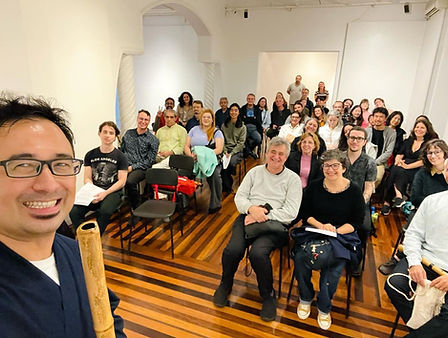
PHOTOS TOP TO BOTTOM: Irlandini's lecture - performers and friends - Sulzbacher's workshop participants
EISSC - I


.jpg)

PHOTOS TOP TO BOTTOM/RIGHT TO LEFT:
Workshop with Marco Lienhardt - Irlandini and Lienhardt during workshop -
Suzbacher and Lienhardt performing - Irlandini's lecture - Sulzbacher and student in Laguna

